Trekking Poles: Are They Worth It and How Do You Use Them?
Walk into any mountain car park and you will see them: two poles strapped to a rucksack, or swinging along a ridge. Trekking poles divide opinion. Some walkers treat them as essential kit; others see them as clutter that gets in the way of a decent view. Both camps are right, depending on where you are going. Used well, poles take real load off your legs on long descents, give you a third contact point on greasy ground and keep a rhythm going on a steep climb. Used carelessly, they are weight you carry for nothing and something else to trip over. Here is how to work out which camp you are in.
What poles actually do for your knees and balance
On a descent, your quadriceps work as brakes. Every step down a steep, rocky path is a small controlled fall, and your knee absorbs the shock. Plant a pole and push against it, and some of that braking force travels through your arm, shoulder and back instead. It is not magic, and it will not fix an existing injury, but over a long descent it adds up. Most people notice the difference the following morning, when the stairs at home suddenly matter.
The balance benefits are harder to measure and easier to feel. A pole gives you a third point of contact on loose scree, wet rock, muddy stiles and river crossings. It lets you test depth before you commit a foot. It helps you hold a steady pace uphill when your legs want to slow down, and it gives your upper body something useful to do rather than hanging off your shoulders. Backpackers also use poles for probing boggy ground, easing weight off a tired leg and, with a tarp, as shelter supports. That is a lot of jobs for a pair of sticks.
Who gets the most out of them
Poles tend to earn their place when one or more of these apply:
- A heavy rucksack, especially on a multi-day trip
- Long or steep descents, which are far harder on the knees than climbs
- Rough, unstable ground: scree, boulder fields, wet grass, deep mud
- Knees that complain after big days out
- Winter walking on hard-packed paths where a slip is likely
- Long days when fatigue arrives and your foot placement gets sloppy
If your typical walk is a flat towpath, a gentle woodland loop or a lowland ramble on good paths, you can leave them at home without missing much. On easy ground they add weight and noise and do very little else.
Setting the height correctly
Most pole problems start here. Too long and you will hunch your shoulders and push yourself backwards; too short and you will stoop, which is exactly what you were trying to avoid.
The elbow test
Stand on flat ground with the tips on the floor beside your feet. Adjust the pole until the top of the grip sits comfortably in your hand with your arm relaxed and your elbow bent at roughly a right angle, forearm level with the ground. That is your baseline for gentle terrain. Tighten the clamps or twist locks firmly, then press down hard on each pole to check it does not slide. Slipping poles are miserable and slightly dangerous; if a lock keeps giving, clean the section and re-tighten rather than forcing it.
Adjusting for the hill
Shorten both poles by a few centimetres for a long climb, so you can push down and behind you. Lengthen them by a similar amount for a descent, which puts the tips further ahead and gives you something to lean into. This is the single habit that separates comfortable pole users from the ones who carry them folded for half the day. If you adjust often, mark your favourite settings with a strip of tape so you can reset them in seconds without thinking.
Technique that makes them work
Poles are not crutches to be dragged along; they are propulsion. A few habits do most of the work:
- Use the straps properly. Slide your hand up through the loop from below and grip the handle and strap together, so the strap runs across the back of your hand. Push down through the strap and you barely need to squeeze the grip. This saves your forearms on a long day. On very steep or exposed ground, some walkers loosen or skip the strap so they can let go instantly — a fair trade-off, as long as you accept the extra grip effort.
- Match pole to opposite foot. Plant the right pole as your left foot lands, and the left pole with your right foot. This keeps your rhythm natural instead of clattering along like a wind-up toy.
- Plant slightly ahead, then push. The tip goes down in front of you, then travels back past your hip as you step through it. That backward push is where the effort-saving comes from.
- Keep the tips close to your line. Reaching far ahead wastes energy and tips your weight backwards on climbs.
- Swap hands on gentle terrain for a few minutes now and then, or carry them across your body, to give your shoulders a change.
A small kit note: carbide tips bite into rock and gravel, while rubber feet are better on tarmac and stone paths — quieter, and kinder to surfaces where land managers ask for them. Tips are replaceable and cheap, so swap them when they round off.
When poles are a hindrance
There are places where poles cost you more than they give. On a scramble, you need your hands for rock, and a pole dangling from your wrist is a liability. The same goes for steep snow and ice unless you know exactly what you are doing. In dense vegetation, on narrow paths with others close behind, or through a run of gates and stiles, the constant folding, carrying and swinging gets tedious fast. Long stretches of flat tarmac are another case for strapping them to the pack. If you find yourself using poles to compensate for a knee that hurts on every walk, the sensible move is to have that checked properly rather than to lean harder on the kit.
Starting sensibly
Borrow a pair before you buy. Set them with the elbow test, use the straps, adjust for the first big descent you meet and give it three proper walks before you decide. If you do buy, telescopic poles adjust in fine steps and suit mixed terrain; folding poles pack small and are handy if you travel with them. Aluminium is generally tougher and cheaper, carbon is lighter but can fail more abruptly when it does. Cork grips feel cooler in summer heat and mould to your hand; foam is lighter and cheaper.
The practical rule is simple. If you finish a day with aching knees and tired quads after a long descent, poles are worth trying. If your walks are short, flat and on good paths, save the weight and enjoy the freedom of empty hands.
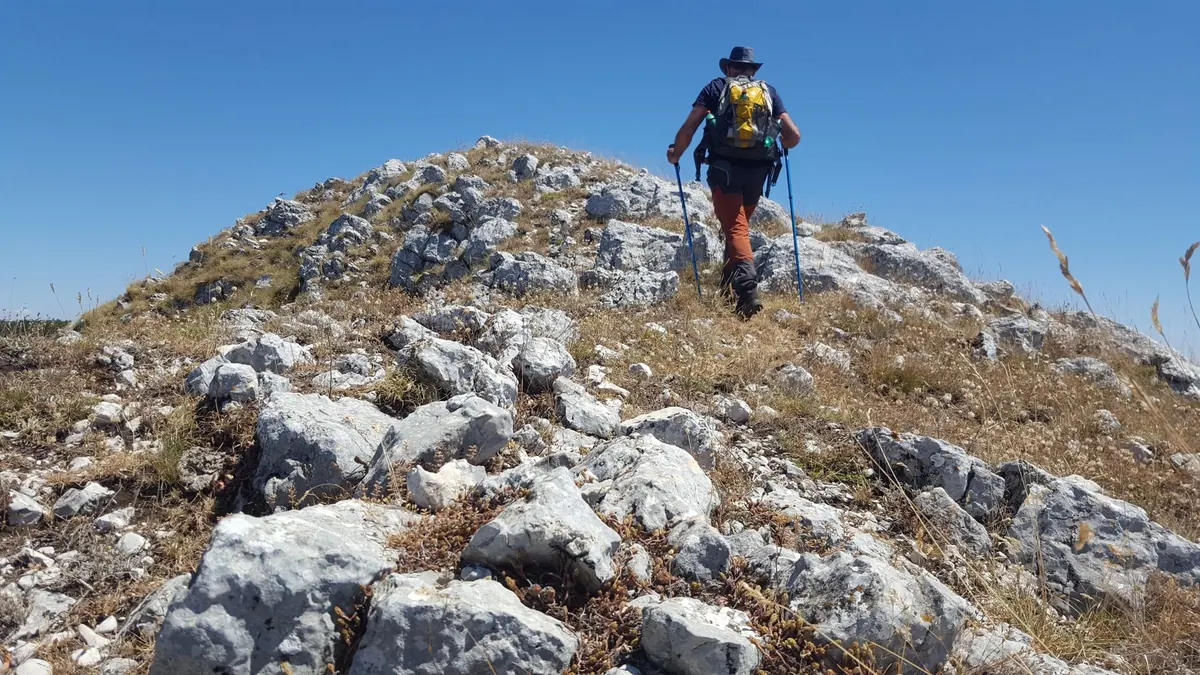
Photo: Salvatore Monetti / Pexels
You Might Also Like
A practical guide to planning a first three-day Lake District hike, covering route choice, realistic daily distances, beds, resupply and what to do when plans change.
Gas, liquid fuel and alcohol stoves each shine in different conditions. We compare weight, fuel availability, cold-weather performance and cost for British camping trips.